theEucharist

  • Subscribe to our RSS feed.
  • Twitter
  • StumbleUpon
  • Reddit
  • Facebook
  • Digg

Saturday, March 30, 2013

No Feet instead an offering for the poor

Posted on 5:03 AM by Unknown

I used to wash the feet of women because I merely saw it as a sign of service and then the Holy See clarified the theology of it and issued its decree that only the feet of men should be washed, as it was a sign of Christ serving the disciples (really the Apostles). It is a sign about the Church and Christ's service of it, rather than a general sign of charity, it is very much a sign ad intra rather than ad extra. From a Russian friend I understand the Patriarch of Moscow washes the feet of twelve Moscow bishops, which seems entirely appropriate, the Apostles were after all bishops. It was also appropriate that formally the Bishop of Rome should wash the feet of twelve priests of his diocese.
In my mothers homeland, that bit of Northern Italy that became the Yugoslavia, it was the custom of my grandfather, and the heads of most households, to wash the feet of his family and farm workers, the practice I understand continued even under Tito's Communism. In England before the Reformation the monarch used to wash the feet of the poor, and in at least one Benedictine Abbey I know Mother Abbess washes the feet of the whole community in the Chapter house, in the Liturgy the chants are sung but the priest washes no-one's feet. Formerly it seems it was a ritual for those in authority to exercise with their subordinates.
This year I have found bending, even walking rather painful, it is passing now but Wednesday I had to use a stick just to walk into Church, so as it was physical painful and difficult to do, but also because of doubt about the Law raised by the Pope, frankly I just didn't want the hassle I had trying to get people to accept the change in the Law, especially as most of the local brethren do any feet available. So I decided that as it was optional we would opt not to wash feet. I never have a list and just invite men to occupy the 12 seats put out by the servers. It is the first time I haven't done it.
As the choir had prepared the Mandatum, and as I stress the 3 collections of the Triduum, for the poor, the Holy Places and on Easter Day for the clergy, in our diocese it is an important part of the PPs income, so I asked the servers to place the bowl and towel before the sanctuary and invited people to come up and place their offering in the bowl. The money was for the poor, we will give it to the local Coptic Church as a fraternal act, to be used to help the Christian refugees from Egypt, recently 250 families have arrived in Brighton fleeing for fear of their lives.
Afterwards someone said it was a little more "meaningful" seeing a bowl full of notes, a sign of the effective charity from the community for members of our extended community.
Read More
Posted in | No comments

Friday, March 29, 2013

Good Friday Sermon

Posted on 11:28 AM by Unknown


Judas and the High Priest agreed that the price of Jesus was thirty silver coins, enough to buy a small field.

Today in our post Christian world we like to put a price on life, many women have abortions because the feel they can't afford a child, or couples defer having a child because of the cost, gay "marriage", where it has been introduced has been a boon to those in the surrogacy business, in some third world countries there is a growing business in renting wombs and selling babies. The Staffordshire and other hospital scandals, again remind us that human life, caring for it and cherishing it, has a cost. Keeping someone alive on expensive has a cost, and as countries become poorer the cost will become more and more important, and it will become part of the debate as more and more people start to advocate euthanasia.

How much a human life?

Judas sold Jesus for thirty pieces of silver.
The message of Christianity is that God pays for us, "to ransom a slave he gave away his Son", How much has God paid for me? For me, he has given away his only begotten Son. He tells me, sinner, rebel, God-hater that I am, that I am worth the Son of God, I am worth the Creator, that is the value he places on us: everything. And the amazing thing for all of us, the beggar, the old man, the victim, the torturer, the unborn child, the newly conceived child, God says all these, just one of these is worthy of a God as a ransom. When Jesus is denied or pushed out of the public sphere we lose sight of our value and the value of everyone.

This is the message of Good Friday; the unimaginable value God places on us. This is the message we have for the world and for every individual in it: God places an infinite value on you. We show it by trying to love the least of all.
Read More
Posted in | No comments

Thursday, March 28, 2013

A Society of Robbers or the Church?

Posted on 12:19 PM by Unknown
In this photo provided by the Vatican newspaper L'Osservatore Romano, Pope Francis washes the foot of an inmate at the juvenile detention center of Casal del Marmo, Rome, Thursday, March 28, 2013. Francis washed the feet of a dozen inmates at a juvenile detention center in a Holy Thursday ritual that he celebrated for years as archbishop and is continuing now that he is pope. Two of the 12 were young women, an unusual choice given that the rite re-enacts Jesus' washing of the feet of his male disciples. The Mass was held in the Casal del Marmo facility in Rome, where 46 young men and women currently are detained. Many of them are Gypsies or North African migrants, and the Vatican said the 12 selected for the rite weren't necessarily Catholic. (AP Photo/L'Osservatore Romano, ho)

I do not believe it is a big deal for Pope to wash a girl's feet. He can do what he likes and change whatever Law he wishes, indeed it will be seen as a very popular move by the media and the majority of Catholics, who fail to understand this action as a sign of Christ washing his Apostles feet.

It is however a very big deal for the the Supreme Legislator of the Church to break the Church's law or to set those laws at nought, especially as Supreme Legislator he has the right to change the Law. It does not bode well for a "Reforming" Pope to do it.

I don't want to join the doom and gloom merchants but if the clergy of the Church, as well as the Pope, can choose  do without its Laws then either we have become perfect society or we indeed have society of robbers and internal cohesion of the Church is broken and where that happens it becomes a place where brotherly love turns into mere Relativism and we have returned to the age Borgias.

Then I will be free to marry, or to marry same sex couples, admit those living in adulterous unions or even admit non-Catholics, pagans and pet dogs to Holy Communion, refuse to hear Confessions. I could even if so felt inclined prostrate instead of genuflect after the Consecration, and if I was a bishop ordain women to the diaconate or even the presbyterate or episcopacy, if were a lay person, an abortionist for example, why shouldn't I go to Holy Commion?

Keeping the law is a mark of Communion. Without the Law anything is possible, no-one has protection or rights, the guards are unguarded and no-one can be trusted!

This little scene from A Man for All Seasons is perhaps apposite.
Read More
Posted in | No comments

Wednesday, March 27, 2013

A Jesuit Pope and the Two Standards

Posted on 5:54 PM by Unknown

"I will destroy the Church."
"But the clergy have been doing that for the last two thousand years, and still they haven't succeeded".
This conversation has been attributed to various people, my personal preference is Napoleon and the great Cardinal Consalvi.

Anyone who wants to reform the Church has to start with the clergy, and with the senior clergy at that. The absence of O'Brien and the presence of Daneels and Mahony, to name but two, must have introduced into the Conclave itself a certain stench of at least one element of the filth that both Benedict and now Francis have spoken about.
In the pre-Conclave intervention which was revealed yesterday, Cardinal Bergoglio said this:
When the Church is self-referential, inadvertently, she believes she has her own light; she ceases to be the mysterium lunae and gives way to that very serious evil, spiritual worldliness (which according to De Lubac, is the worst evil that can befall the Church). It lives to give glory only to one another.
Even Kung in his more orthodox days had said, "When the Church preaches the Church it ceases to be the Church". The worst aspects of the scandals that have hit  the Church are the self serving cover-ups of so many bishops, the Pope has already warned about the dangers of the Church becoming NGO. There is a serious risk that we can become an organisation that is associated with the rich and powerful rather than the poor and powerless.

The reception of Tony Blair with no repudiation of some of his more blatantly anti-Catholic policies scandalised many of us, as did the former Director of the CES. Oona Stannards relationship with Ed Balls and Labours anti-Catholic education policies. In the US the same could be said about the relationship of the chuckly Cardinal Dolan and the Obama government. Both CMOC and Dolan and hundreds of other bishops might well say they are being compassionate. Even the rich and powerful deserve compassion, Here Pope Francis' motto is interesting: “By showing compassion and by choosing”, compassion alone can be dangerous, there is a necissity "to choose".

"Choosing" or discerning seems to have been lacking in the Church and where choices have been made they have often left people confused. At the heart of St Ignatius Spiritual Excerccises is the choice between the Two Standards or Banners, one belongs to Christ, the other to the Prince of this World. Those doing the excercise must make the choice. The Church itself and its leaders, as must all Christians must make the choice which ultimately is Christ or the Devil. Now what was it Francis has said about prayer: Whoever does not pray to God, prays to the devil!
In his meditation of the second week of the Spiritual Exercises Saint Ignatius of Loyola presents to us "On the Two Standards" telling us we are faced with making a choice: "The one of Christ, our Commander-in-chief and Lord; the other Lucifer, mortal enemy of our human nature." Loyola places in front of us the choice of how we are going to live our lives, either for Christ or against Christ, either for good, or for evil. Why sell our soul for money, power and fame when the Lord offers us a life that's attractive and beautiful through the virtues of spiritual --and possibly in actual poverty, contempt for worldly honor and humility against pride? Poverty, whether spiritual and/or actual, obedience and humility are virtues that lead to all other virtue and everlasting life in Jesus Christ.
I am beginning to think of Pope Francis as being rather like an old fashioned Jesuit missioner. Those who knew those two Jesuits Fr Hugh Thwaites and Fr John Edwards, both of whom died in the last few months, who I can't help thinking of as the last of the English Jesuits, might understand from them something of Pope Francis' spirituality.

At their heart was the choice that they had made to stand under the standard of Christ. They had a "stripped down" attitude to life summed up in Fr Hugh's battered old car, or Fr John's simple hitting between the eyses preaching. Both were men who were hungry for souls, who could distill the faith into a few short words, both lived it uncomprisingly themselves, both desired it to be contagious, and both were men of profound devotion (and to be honest both were devout but ghastly liturgists, Jesuits, for the most part, don't understand liturgy). But most importantly they expected those they came in contact with to make the choice for Christ, they would encourage, speak about the sweetness and the joy of the Cross. There was nothing flabby or efete about their spirituality, it was the same spirituality that had led Campion and Sherwin to Tyburn and Francis Xavier to the ends of the world. It also led them to be despised by many of their own brethren, and to be regarded as saints by the poor they gave their lives to serve.
Read More
Posted in | No comments

Monday, March 25, 2013

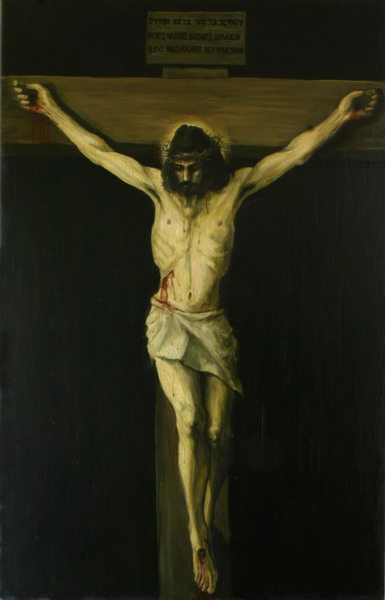
Why Have You Forsaken Me?

Posted on 10:03 AM by Unknown

Salvador Dali's oil painting Crucifixion or Corpus Hypercubicus

"My God, my God why have you forsaken me".
Why does the Lord make this cry from the Cross?
It is a quotation from Psalm 22, it begins with emptiness but actually ends in triumph. Nevertheless the words that Jesus chooses to quote are barren and bleak.

The whole process of crucifixion, and one may suspect Jesus' crucifixion especially, was to turn him into a "man despised and rejected" in the eyes of the population, and in his own eyes to become a "worm and no man". It was not just the physical destruction of Jesus that was desired but his annihilation in every way. The one who claimed equality with God has to be reduced to less than nothingness. It is part of Divine humility that the Son of God should place himself under mankind, not merely taking on death but in a sense placing himself under death itself, hence the dreadfulness of his death.

Some have suggested that this cry is really a loss of faith on Jesus' part, that sees his mission turned to nothingness, that his Father really has deserted him. I am inclined to agree to a point. The humiliation of Jesus is one suspects only partially described in the Gospels. We are left to imagine quite what his torturers actually did in darkness of the Praetorium it can only be seen by the darkness of the human soul, Roman torturers were as professional as their modern brothers and knew how to make a man confess, to break him, or to reduce him to whatever the chose. It presumably wasn't just physical pain but psychological and emotional pain they could inflict. Crucifixion is a terrible death but there are worst deaths, Jesus' death is not merely about the visible suffering and the destruction of his body but the disintegration of his very being.

Jesus in his humanity is a the Man of Faith.
How does he know he is the Son of God? Surely in the same way that we know are by adoption sons (or daughters) of God, it is by Faith, that is how human beings relate to God. To suggest anything else would be to suggest that Jesus was hybrid God-Man, and therefore a denial of the most essential Christological doctrines.

 During his life, like us, he experienced moments of deep contemplative intimacy, perfect union with God, at times like the Transfiguration or Baptism, times when faith gives way to absolute certainty, in human terms, when the veil of human limitation dissolves and there is perfect and intimate knowledge. As Catholics we have to believe that Jesus has before him the Beatific Vision always. It is legitimate to ask, how he had it. The struggle in Gethsemane would suggest that it was by subjecting his human will to the Divine will, this was obviously no painless experience. We humans want to flee death and pain, it is our nature but Jesus' will is to conform his humanity (and ours) to that of the Father, in that sense "he learns obedience through suffering".

I don't think this is heresy but it seems that at the end in Jesus all that existed was faith, all that might have sustained his relationship with the Father is gone, miracles are gone, prophecy is gone, the sense of delight in God has gone, there is no sense of the Presence of God, or even his comfort. Hence Jesus by pure and perfect faith in absolute desolation, cries out, "My God, my God".  This is perfect obedience, what our first parents lost by seeking knowledge, Jesus restores by the absolute pain of the loss of knowledge, the absence of any comprehension of God, in total human misery and alienation.

His faith exists when everything else that leads him to feel or experience God is absent. This is the Divine Dark Night of the Soul when everything dissolves except God, even Jesus' human image and understanding or intuition of God. The immensity of Jesus capacity and yearning for God is drained, empty, dried up, he thirsts, for mankind but infinitely more so for God. There is no vision, only darkness and emptiness and numbness.

Jesus in his perfect humanity stands face to face with God in uncomprehending comprehension abandons himself to God. There is nothing left but Faith, the Union of God and Man and nothing in the desolation of the Cross to support Faith but Faith, itself and in the emptiness of the Faith absolute Divine Love and resignation to the Will of God. There is nothing left but  for Jesus to place himself into the hands of the Father in the darkness of his pain a alienation.

This is the supreme act of divine kinosis, Jesus breathing forth his Spirit into the Eternal emptiness and darkness of God and in so doing he fills and enlightens humanity's with His Spirit.
Read More
Posted in | No comments

We are Brothers

Posted on 6:20 AM by Unknown
The two popes: Francis and Benedict XVI

There is nice little piece by Tornielli on what unites the Pope and Pope-Emeritus. I think we should regard them as, "Brothers". Tornielli also puts pay to the rather rude remarks to Mgr Guido Marini, that flashed across certain blogs, which from what we have seen so far seems quite out of character.

P.S.
I like the idea of Pope Francis "recycling" presents, the icon he gave to Benedict had been given to him a few days earlier by Metropolitan Hilarion.


P.P.S.
What are those white boxes about, is it the same box?
Read More
Posted in | No comments

Saturday, March 23, 2013

Francis might teach us to be good

Posted on 5:58 AM by Unknown

I have been a little out of touch with things lately, I have only just read the latest in the Cardinal O'Brien saga, I don't know if it is true but it has the smell of truth about it.

I don't know how the Papacy of Francis is going to pan out, 10 days is a bit short to judge. I was rather heartened by the words of one of my parishioners, "Pope Benedict taught us to think, Pope Francis might teach us to be good". I like that, I think we, especially the leaders of the Church have forgotten we must be good.

I think Pope Benedict really did teach us to think, to return to original sources, to the actual words, not just of the Council but of Scripture and the Fathers, but really of the Word Made Flesh, Francis I hope may well teach us how to live out the Gospel.

The dichotomy between the goodness of the Gospel and the sometimes wickedness of Christians is shameful. The secular media are right to pillory us for hypocrisy. The Gospel cannot be an abstract concept, Jesus cannot be vague ideas, the Gospel has to be about the Word being made flesh, Jesus has to be seen in his Church, and made visible in the darkness of the world.

The synoptic Gospels are full of imperatives, "do this", forgive, show mercy, even, "cut off your hand", "pluck out your eye" and the Gospel of John speaks so often of "works", "evidence", "witnesses". Jesus' teaching is backed up by solid examples of his own good works, of miracles, and his own death and resurrection.

The secular media's main complaint, and it should be taken seriously is that we, the Church, are not good, that we are hypocritical. We cannot blame the world if it simply does not see the Gospel lived in the lives of Christians, and as priests and bishops we cannot blame Christians if they do not see the Gospel lived in the lives of their leaders.

The real problem in the Church is our failure to lead effectively, and that isn't about management, it is simply about lack of commitment to the Gospel, the failure to even attempt to put it into practice. It is worth considering that leadership in the Church is ultimately about leading people to Jesus Christ. Pope Francis might well at times be a bit crass, his language might even be a bit more like a fisherman than a prince of the Church at times, he might even make liturgical blunders or even theological errors of judgement. As Archbishop he seems to have won over many and alienated a some but he seems genuinely to have tried to be authentic witness, a believable witness.

As a Church, and as Christians, we have nothing to offer except Jesus Christ, the world recoils from hypocrisy but it still wants to see the face of Christ. For the last 50 years the Church has been concerned about its own self, this has been disastrous both for itself and for the world, its fruit is the people outside of it no longer see Christ in it, and people inside it no longer believe in what Christ teaches. The result is we produce no fruit and as Jesus says. "By their fruits you shall know them". We can talk all we like about faith, but without works it is dead!
Read More
Posted in | No comments
Newer Posts Older Posts Home
Subscribe to: Posts (Atom)

Popular Posts

  • Thoughts on the new Prefect of the CDF
    One of my parishioners a nice young single mum was discreetly picking up cigarette ends in the street. She is addicted, she can't afford...
  • More on Müller
    Following on from a post yesterday of the new CDF Prefect, there was an interview on Vatican Radi o with Archbishop Gerhard Ludwig Müller. ...
  • Lello Scorzelli's Ferula: a return to the past
    Broken, tortured, twisted, contorted are the words that come to mind looking at this crucifix. It has the sense of  being in flux, half-form...
  • SSPX's Problems
    Recently the SSPX Bishop Tissier de Mallerais revealed during a conference a letter written by Benedict XVI which says an agreement between ...
  • Vocations: thoughts
    I am a bit anxious about our parish's liturgical future, we are loosing our Master of Ceremonies, he believes God is calling him to the ...
  • The Nuncii
    I was chatting to a couple of Irish friends yesterday, both rather spontaneously said in the words of the second, "Charlie Brown: he...
  • Orbis Volvitur
    Crux stat dum orbis volvitur The Cross stands still the Earth revolves In monastic life a great deal revolved around the Exaltation of the H...
  • Come to judge the quick and the dedde
    One of the problems of being an aging and solitary celibate is not having a wife or superior to nag you about visiting the doctor; I wasn...
  • "Vatican II: A discussion that can no longer be stopped"
    Under the heading, "Vatican II: A discussion that can no longer be stopped".  The excellent Rorate Caeli says: Whatever might be s...
  • Norah Out!
    Apparently Ma Popehater can't understand  why Clifton diocese's favourite theologian Professor Norah Batty - head of Cleggy studies ...

Blog Archive

  • ▼  2013 (206)
    • ▼  September (11)
      • Brighton Argus: Contacting Advertisers
      • Procrastination and the Argus
      • A new post!
      • A time to keep silent?
      • Pope's Letter to G20
      • Protecting the Bride
      • Bill Gardner: an unscrupulous journalist
      • 'Foetal Remains
      • Realpolitik
      • Bertone: Crows and Vipers in the Vatican
      • Naughty Seminarian
    • ►  August (13)
    • ►  July (29)
    • ►  June (32)
    • ►  May (21)
    • ►  April (17)
    • ►  March (33)
    • ►  February (35)
    • ►  January (15)
  • ►  2012 (294)
    • ►  December (43)
    • ►  November (38)
    • ►  October (41)
    • ►  September (40)
    • ►  August (30)
    • ►  July (25)
    • ►  June (25)
    • ►  May (26)
    • ►  April (26)
Powered by Blogger.

About Me

Unknown
View my complete profile