


 Today is the memoria of Ignatius of Loyola the innovative founder of the Society of Jesus. It is worth considering just how new the Jesuits were, and what a radical break they introduced with all previous religious orders and spiritualities.
There were always hermits living apart, then gradually hermits living together often around one particularly renowned spiritual master. The Church, a community, gradually learnt to favour monks, those who live and prayed in community over those often wild and extreme individuals who lived the wild and often self indulgent though penitential solitary life as hermits.
Monastic life was essentially liturgical, the prayer of monks was the recitation of the psalter, the essential training of a young monk was to teach him to memorise the psalter, and when and how to say it, indeed that is the major concern of the Rule of St Benedict, the Father of Western Monasticism.
Alongside monks were Canons, living an often slightly mitigated monastic life to serve a particularly significant Church. Again their life, though often less concerned with silence and penance, was essentially focussed on the liturgy of the hours. Friars followed, their life was essentially one of teaching and preaching but still with the liturgy, the singing of the Divine Office as the backbone of their life. There were always of course secular clergy whose prime function was to offer at least daily Lauds and Vespers for their congregations, and Mass as well on Sundays and feastdays but primarily they sang the Liturgy of the Hours for or on behalf of their people.
The most radical change that Jesuits introduced was that they were not committed to the common or public recitation of the Divine Office, even in Jesuit houses the Office was said privately, though devotions of one kind or another might be done publicly, the Church's liturgy became an entirely private affair, except possibly with the exception of Sunday Vespers but even this became a source of "devotions" a basis for Rosary, sermon, litanies and Benediction.
Before the Jesuits churches consisted of nave, chancel and sanctuary but because there was not public chanting of the Office, there was no need of a chancel with its choir stalls in their churches and they quickly disappeared from new parish churches and chapels too after the Counter-Reformation. Under Ignatius' inspiration 'liturgy' for the faithful became just the Mass. The Office was said by clergy under obligation, for early Jesuits it was a burden whereas other forms of prayer were a joy.
Another Jesuit innovation was mental prayer - unknown in ancient monastic Rules - but even among the friars, especially the Carmelites it tended towards the via negativa, whilst the Jesuits, following the example of Ignatius' Spiritual Exercises gave full scope to the imagination, 'picturing a scene' moved very quickly from the minds of Jesuits to the walls, ceilings and altar pieces of their churches.
Most importantly the Jesuit disdain for liturgy and preference for devotion brought about a serious change in western theology. In the West and in the East from the very beginning the source, the root, the matrix of theology was the sacred liturgy. The Jesuits became the first to abandon Liturgy as the basis of their theology, which accounts for the wilder excesses of counter-reformation theology and devotionalism, as well as the eccentric theology, based on secular learning, philosophies and sociology that prepared for and followed the Vatican Council.
St Ignatius and his Company of Jesus did extraordinary things for evangelisation following their foundation but their disdain for Liturgy has introduced a fault line into Western Christianity that has deeply wounded our intellectual life and it looks as if it is to continue. Pope Benedict saw the liturgy and a return to the liturgical mystogogical theology of the Fathers as healing, both for the West in particular, but also for the division between East and West, as did VII in Sacrosanctum Concillium and its general call to return to Patristic study. I am not sure whether Papa Bergoglio and most contemporary Jesuits and those who have taken up Jesuit inspired theology understand this, they think as Jesuits, not as people imbued and formed by the riches of the Liturgy. A great many Trads seem to be concerned that Francis is showing himself as antagonistic towards Benedict, I do not know if that is so but what I am convinced of is that Benedict was antagonistic towards Francis and the whole Jesuit non-liturgical school of theology, as is anyone who cares for the Liturgy.


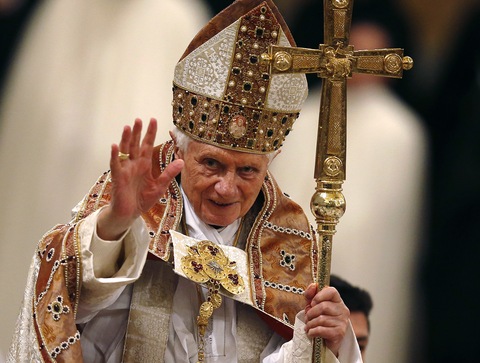
 There are many younger priests and lay people, who seem to share the bereavement of that seminarian, I do myself. After the death of a Pope there is a period of mourning, even cries of 'sancto subito', Benedict's departure was merely marked by the whirl of a helicopter and the closing of the gates of Castel Gandolfo. The three months of Francis' pontificate for many seems to be a going back 40 years to the time of Paul VI when everything was in flux and little was certain. It is not just the signs and symbols of Papacy, or even Liturgy shoes and vestments but theology of continuation that they signified, which is much more important. Francis' casting aside of these things and his preference for a style of forty years ago seems say something of his theological mind set.

![Photo: Some highlights from Prof. Tracey Rowland’s address: “The Usus Antiquior and the New Evangelisation”, June 26th, 2013: - “I want to argue that the usus antiquior is an antidote to the ruthless attacks on memory and tradition and high culture, typical of the culture of modernity, and that it satisfies the desire of the post-modern generations to be embedded within a coherent, non-fragmented tradition that is open to the transcendent.” “The project of the 1960s generation was one of transposing a high sacral language into the vernacular of a low mundane culture, with the result that something sacred became more mundane, and when the sacred becomes mundane, it becomes boring.” “In wrapping the faith in the forms of the contemporary culture and generally correlating the liturgy to the norms of the mass culture, the 1960s generation of pastoral strategists unwittingly fostered a crisis in liturgical theory and practice.” “[The 1960s generation] dismantled a high Catholic culture by removing its cornerstone and they left subsequent generations of Catholics in a state of cultural poverty, confusion and boredom.” “A Catholic who is ignorant of [the usus antiquior] is like a student who majors in English literature but is unfamiliar with Shakespeare.” “It may be argued that [the] usus antiquior was the one thing that could bring the warring European tribes [of the 20th century] together.” “[Benedict XVI] compared the pastoral strategy of bringing God down to the level of the people with the Hebrew’s worship of the golden calf and he described this practice as nothing less than a form of apostasy.” “It would be a major advance if those responsible for liturgical decisions could at least get the message that modernity has not been fashionable since the 1960s.” “Elements of Catholic culture which were suppressed by the 1960s generation of pastoral leaders are being rediscovered by younger Catholics who treat them like treasures found in their grandmother’s attic.” “Catholics of the post-modern generations want to know how the Church looked, how the faith was practiced, when there was a coherent Catholic culture.” “The whole structure of the usus antiquior engenders a deeper sense that there is a sacrifice, not a mere meal… There is really no greater antidote to secularism and what Pope Francis calls a ‘self-referential Christianity’ than a reflection on martyrdom and the sacrifice of Calvary and the Roman Canon sustains a person’s reflection on this reality.” In an era when globalisation is regarded as a good thing and governments spend millions of dollars of tax-payers’ money to keep alive the memory of minority languages and pre-modern social practices like Morris dancing, the Church should not be ashamed of her own cultural treasures.” “The usus antiquior should be a standard element of the cultural capital of all Latin Rite Catholics since is so effectively resists secularism and satisfies the post-modern hunger for coherent order, beauty and an experience of self-transcendence.” “I believe that the proponents of the usus antiquior are often their own worst enemies and foster practices and attitudes which deter many Catholics from attending Masses according to this Form.” “The obsession with dissecting every minute detail of the event is a symptom of what Joseph Ratzinger called the problem of aestheticism.” “If pastoral pragmatism and its inherent philistinism is a problem at one end of the spectrum, aestheticism seems to be the problem at the other end of the spectrum.” “Ordinary Catholics do not want to feel as though in attending the usus antiquior they are making a political stand against the Second Vatican Council.” “The more [ordinary] people feel as though a whole raft of theo-political baggage comes with attendance at the usus antiquior Masses, the less likely they are to avail themselves of the opportunity to attend them.” “To evangelise post-modern people [the Christian narrative] has to appear to be something starkly different from the secular culture they imbibe which is a culture parasitic upon the Christian tradition but completely decadent.”](https://fbcdn-sphotos-e-a.akamaihd.net/hphotos-ak-ash3/p480x480/1044879_381603408606092_1625352538_n.jpg)


